Friday, October 7, 2011

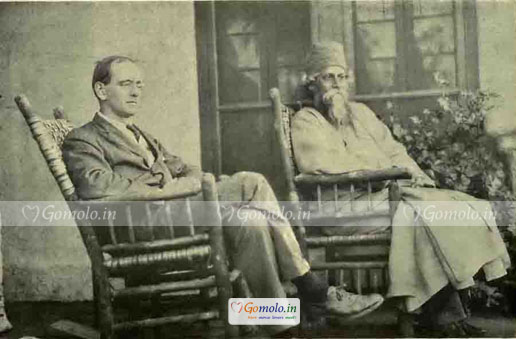
Rabindranath in Hampstead

Hampstead is an area of London, England, 4 miles (6.4 km) north-west of Charing Cross. Part of the London Borough of Camden in Inner London, it is known for its intellectual, liberal, artistic, musical and literary associations and for Hampstead Heath, a large, hilly expanse of parkland. It has some of the most expensive housing in the London area, or indeed anywhere in the world, with large houses selling for up to £50m (2008). The village of Hampstead has more millionaires within its boundaries than any other area of the United Kingdom
 Rabindranath stayed in that boarding house for some days.Then they got a small house on rent for six weeks. Rathindranath wrote Nagendranath,
" We hired a house on rent for 6 weeks at Hampstead Heath. It was too much expensive in a private hotel."
Rabindranath also wrote Madhurilata ( 21 Jun Hampstead),
"We have hired a small house and are trying to establish our household here. We have picked up Kedar, and Rathi has gone out with him". The address of this new house was 3 Villas on Heath/Vale of Heath/ Hampstead/London NW.
Sukumar Ray wrote his father Upendrakishore,
"I went to meet Rabibabu in the morning. The place , they live, is very beautiful. It seemed that it is far away from London. It is hilly with high crests and troughs. There are trees and hills here and there. But the place is calm and quiet. The house of Rothenstein is very near to this place."
Somendra Chandra Devbarma and Kedar Nath Dasgupta stayed with them in Hampstead.
Rabindranath wrote Mira Devi describing their life style there;
" My daughter-in-law (Bauma) has started her new house here and gradually getting contacts with the working boys and girls. They are so accomplished that we are filling quite comfortable. We have hired a complete house from yesterday and hope that we shall be alright here. Somendra is with us. Bauma is visiting many places here. I don't get inspired in moving here and there. I am quite absorbed here with the people of this place. I am busy with parties day and night. But I am not accustomed. They are so heartily, I can't help accepting their welcoming attitude. We have hired the house for six weeks and then we shall move to some other place.
I can't say that my Bauma is the head of the house hold affairs here because Kedar Dasgupta is doing every household affairs. He is living here with us."
While living in foreign, Rabindranath did not feel writing anything, specially poetries, in Bengali. But the natural scenery of this place was so beautiful that he was charmed and wrote two poems in Bengali.
On 23 June, he wrote, "Taba Rabikara ase Kara Barhaia" , and on 25th June, "Sundara bate taba angadakhani"  and he mentioned the place of the two poetries as ' The Heath/ Two Halford Road/Hampstead.' Not only he wrote the two poetries in Bengali, he translated those poems into English and sent a letter to Rothenstein enclosing the above two poems translated into English.
" I send you some more of my poems rendered into English. They are far too simple to bear the strain of translation but I know you will understand them through their faded meanings."
These two poems belonged to the 8 poems of Gitanjali which were missing.
Ajit Kumar Chakraborty sent a poem similar to that "Taba Rabikara..." to Rabindranath in English after receiving the former.           
    

Thursday, October 6, 2011

Rabindranath and Sukumar Roy

The meeting held at Pearson's house in Hampstead Heat on 19th June was described by Sukumar Ray to his sister Punyalata Chakraborty (1889-1974)in letter a dated 21 June (Friday 7th Asharh);
" Day before yesterday, I was invited to read a paper on Bengali Literature at Pearson's ( he has replaced Dr. P.K.Ray ) house.I went there and saw Mr. & Mrs. Amold, Mr. & Mtrs.Rothenstein, Dr.P.C.Roy, Mr. Sarbadhikari and many others already known to me. There were some Europeans ( Male and Female) whom I do not know. Not only those persons, after entering the room I found Rabi Babu was also sitting there. You could well understand my state of mind. Any way, I read my essay unhesitatingly. Though I took much labour in constructing the essay. I consulted books for material collection borrowing books from India Office Library. Moreover, I took the help of some poems written by Rabindranath (Sudur, Parash Pathar, Sandhya, Kunrir bhitare kandiche Gandha etc.) which I translated into English. Every one praised all those translation. .... Rothenstein took my address and said ' you must come tour place and stay in to dinner.' Then I went to the top of Rothenstein's building and saw a beautiful sight."
I met there with Rathindranath also. Having seen me Rabindranath said, " now, physically you have improved yourself.
The translated forms of the poems of Rabindranath made by Sukumar Ray was not published but the essay " The spirit of Rabindranath Tagore",  written by him with the translation of "Ami chanchala he" was published in "The Quest (vol-V, Oct 1913)".
The letter written by Rabindranath to Ajit Kumar before and after the occasion of 19th June (5th Asharh) determined his (Ajit Kumar) future way of life;
" The  translation of 'Sab Payechir Desh' into English done by you has been published in "Nation".  I shall try to send it to you today. Every one  said high of you. Just on that day, Lady Bytes said to me, 'an ordinary graduate of your country can do so high literary work in English is difficult to think of' .'
I had some talk with the editor of the series "Wisdom of the East", Cranner (Cranmer)Byng yesterday- he told me that he likes to publish the translation of Gitanjali in his  Series. But Rothenstein declined and said we shall not allow anybody to publish your book other than the topmost publication. They are of opinion that they shall do in consultation with Yeats. Rothenstein said,  "Yeats know you, and likes your construction. Very soon I shall meet Yeats. I shall soon be included in the circle of Wells, Bernard Shaw etc.
It seemed that the possibilities of discussion about the translation of Rabindranath's poem with Yeats   came up this time. In fact, the name of Rabindranath was well known among the India-lover English man associated with the India Society. Those who had returned from India such as Havel, S.K.Radcliff, Rothenstein, Kumaraswami, etc  already knew him personally. Persons like Arthur Fox Strangways  and many others had also followed their view. Some might have gone through his translation published in Modern Review. The translation of Sabpayechir Desh by Ajit Kumar published in Nation  in the title "The country of Found-Everything" was not at all negligible.
It can be remembered that even after many attempts made by Jagadish Chandra and Nivedita, some translations of short stories of Rabindranath could not be published earlier.Arthur fox Strangways (1859-1948) was the Secretary of India Society. Rothenstein wrote in his memoir, " this person tried so that the Oxford or Cambridge University offered Rabindranath an honourary D.Lit diploma. But that was turned down by the then Chancellor, Lord Curzon,  of Oxford University on the argument that 'there were  more distinguished men in India than Tagore'.
It was evident that he did not like Rabindranath for his patriotic songs during Swadeshi movement. This idea was expressed  by Mary M. Lago in a letter written to Rothenstein on 12 Jun which said "of one who had added politically to the labours of the Viceroy". In this letter she proposed to throw a dinner in the name Rabindranath to felicitate him by India Society.
This to be noted that Rabindranath landed England on 16th June, 1912 and the letter was written on 12 June, 1912.

Wednesday, October 5, 2011

Rabindranath and Pearson (1881-1923)

Pearson passed B.Sc. from cambridge University, came to India on Dec 1907 and served as a professor in London Mission Society College (L.M.S.College), Bhawanipur, Kolkata, in Biology and undertook responsibility for preaching Christianity in India. He learned Bengali language and joined many ceremonies in India He delivered several lectures on many occasions in Debalaya founded by Shasipada Banerjee. Rabindranath could not meet Pearson in Calcutta but he was concern about Rabindranath which was evident from the English translation of  "Pabna Pradeshik Sammelan Upalakshe Sabhapatir Baktrita" by Rabindranath. This we came to know from a letter written by him from 16 Elgin Road. (published in " The Bengalee dated 18 Feb 1908). Pearson learnt Bengali after this and read collection of writings of Tagore and his thoughts. He built up regards for Rabindranath Tagore. In a condolence  meeting held on 25th Dec 1923 ( 9 Paush 1330), after the death of Pearson, Rabindranath said before his associates of Ashram at Santiniketan  while he recollected  his first meeting with
Pearson;
" I met him first in England. When I first went to his house, I saw a handsome-looking youth standing in front of the door with serene appearance .Having seen me he bowed down his head and touched my feet. I didn't expect of it and became astonished. Many of his relatives were present there who might think that the act was beneath the dignity of their country, he belonged. Because they possessed the victory symbol on their forehead.     
To bow down one's head with  victory symbol is disgraceful to the prestige of his country. Rabindranath had no knowledge about Pearson. Describing the incident Rabindranath wrote to Ajit Kumar,
  "Yesterday, an English man came and all on a sudden he bowed down his head before me and took dust from my feet and said, 'you are our Gurudev. We are waiting for you. Once he was an ICS and knew a little bit of Bengali."
The news was published in Modern Review in Aug 1912  after getting it from Ajit Kumar in the following lines;
" Enthusiasm in certain circles runs so high that a retired English member of the Indian Civil Service on meeting the poet made obeisance to him in Indian fashion, 'taking the dust of his feet'.
In the mean time Rabindranath got the information about Pearson and became ashamed. He wrote to Ajit kumar;
" The person who took dust from my feet was not an ICS. but I shall not disclose before you about his identity for you will publish it again.Rothenstein may not know it properly and misinformed me. You may please rectify it."
But it was not rectified.     

(video) The Story of Gitanjali

Tuesday, October 4, 2011

Rabindranath and Rothenstein (contd-1)

Rabindranath's main problem was a good accommodation other than a hotel. At the first information, Rothenstein found an accommodation, temporarily a house, for them. Rathindranath wrote Nagendranath in a letter dated nil,
" We were in a hotel in the city for the first two days -  Rothenstein, when we called on him, arranged a temporary lodging near his house at Hampstead in a private hotel."
It seemed that they had shifted to their new accommodation at 'The Heath', 2 Holford Road, Hampstead on Tuesday, 18 June (8 Asharh).The boarding house, where we remained, was run by two sisters of Beligium origin.
On thursday, 20th Jun, (6 Asharh), Rabindranath wrote Jagadananda Roy from this place.
" We are trying, here and there, to find an accommodation to our choice. In a day or two we may get it.The house we lave at present is better. It is good but it's rent is high. But i'm thinking that it dose not fit in my present income.Since I have come in an aristocratic area, I cannot live underground.To meet with others, or to invite foreign guests to my residence is expensive here. I can't avoid meeting them lest it will become meaningless to come over here"
Rothenstein had good relations with learned circle in England. For which, it became impossible for Rabindranath to live incognito. Rathindranath informed that the great scientist Sir Oliver Lodge came to see Rabindranath and began to discuss about the doctrine of re-birth. He came to know about Rabindranath from Jagadish Chandra. Havel, Anandakumaraswami, the ex-editor of Statesman S.K.Ratcliff etc, the previously known persons might have come to see Rabindranath. Dr. Devaprsad Sarbadhikari (1862-1935) had come to London to join the Conference of the Universities of the Empire as a representative of Calcutta University. He wrote,
" On Wednessday, 19th June (5th Asharh), I went to the Pearson's House at Hampstead Heath by his repeated request after my dinner. Few persons were invited there and only coffee and ice cream were offered to the guests. One Bengalee domiciled in London read an essay on Bengali literature and eulogized much about Rabindranath. Rabindra Babu too was present on the occasion. The meeting was convened for getting him acquainted  with the persons living in England.Rabi babu sung a song    after many requests and charmed everybody."
The conveners were the man Sukumar Ray (Choudhury), domiciled in England and Mr. Pearson, William Winstanley Pearson (1881-1923).
In 1906, Ray graduated with Hons. in Physics and Chemistry from the Presidency College, Kolkata. He was trained in photography and printing technology in England and was a pioneer of photography and lithography in India. While in England, he also delivered lectures about the songs of Rabindranath before he (Tagore) won the Nobel Prize. Meanwhile, Sukumar had also drawn acclaim as an illustrator. As a technologist, he also developed new methods of halftone blockmaking, and technical articles about this were published in journals in England.
( Book )Shantiniketan : the Bolpur school of Rabindranath Tagore by William Winstanley Pearson
14 editions published between 1916 and 1925 in English and Spanish and held by 165 libraries worldwide
We have determined this item to be in the public domain according to US copyright law through information in the bibliographic record and/or US copyright renewal records. The digital version is available for all educational uses worldwide. Please contact Hathi Trust staff at Hathitrust-help@umich.edu with any questions about this item.


Monday, October 3, 2011

Rabindranath met Rothenstein

Dr. Ashru Kumar Sikdar wrote that Rabindranath went to the house of Rothenstein along with Pramatha Lal Sen and Brajendranath Seal. This statement was contradicted by Prasanta Kumar Paul, writer of Rabijibani. He gave a vivid description of the then situation of London. According to him;
" the autobiographer of Rabindranth informed that when Rabindranath went to England (3rd time) then many Bengali student were there. 1. Kalimohan Ghosh, 2. Narayan Kashinath Debal, 3. Arabinda Mohan Basu, 4. Sukumar Roychoudhury (Tata Babu), 5. Kedar Nath Chattopadhyay (Buba), etc.At that time  some renowned persons of India were present there to whom Rabindranath was well known. Such as 1. Pramatha Lal Sen ( Naluda) of Nababidhan Samaj, 2. Philosopher Brajendranath Seal, 3. Acharyya Prafulla Chandra Roy, 4. Dr. Devaprasad Sarbadhikari. Among the students except Sukumar Ray, all of them came to London after a good number of days than Rabindranath. Hence the report of Dr. Ashru Kumar Sikdar does not bear relevant information.
Edward Thomson also created similar confusion. Quoting  Rabindranath , he wrote;
" Then it occurred to me to try to get into touch with Rothenstein... So I looked up his telephone Number, and rang him up, and he came at once, and got me better lodgings. You know that Vale of Health [sic], in Hampstead --absurd name! Well, he got me a house there. He was my neighbour, and came often to see me. Then, one day he said he had heard I was a poet.Could I give him my idea of work?I told him I had some prose translation, but knew the English was not good.However, he took them. After a day or two, he came back quite excited, and said they were the most wonderful things he had ever seen."
That Tomson's representation was the vervatim one was difficult to say. But the words - " Original manuscript of Gitanjali which he brought from India on his initial visit to us at Oak Hill Park" written by Rothenstein did not tally with his description. He also wrote in his autobiography, " At last he arrived, accompanied by two friends  ( Somendra Chandra Devbarma and Kedar Nath Dasgupta, not mentioned) and by his son. As he entered the room he handed me a notebook in which, since I wished to know more of his poetry, he made some translations during his passage from India ... That evening I read the poems. Here was poetry of a new order which seemed to me on a level with that of the great mystics.
The incident which followed was known from a letter written by Rabindranth dated 26 Nov 1932 reads as;
"....  The next day you came rushing to me with assurance which I dared not to take seriouslyand to prove to me the competence of your literary judgment you made three copies of these translations and sent them to Stopford Brooke, Bradely and Yeats. The letter which Bradely sent to you in answer left no room for me to feel diffident about the merit of those poems and Stopford Brooke's opinion also was a corroboration. These were enthusiasticas as far as I remember."    

Sunday, October 2, 2011

3rd Foreign tour of Rabindranath ( contd-5)

(William's two brothers, Charles and Albert, were also heavily involved in the arts. Charles (1866–1927), who followed his father into the wool trade, was an important collector - and left his entire collection to the Manchester City Art Gallery in 1925. Albert (1881–1953) was a painter, illustrator and costume designer. Both brothers changed their surname to Rutherston during the First World War.)   Having reached London Rabindranath and his party got Bloomsbury Hotel. Rathindranath wrote, "After reaching Chairing Station we came to understand that our travelliong agent, Thomas Cook & amp; Sons had arranged accomodation for us in Bloomsbury Hotel and booked for few rooms. We started for Bloomsbury from the station in the  tube-rail. This was my first journey in an underground train. For my excitement of new experiences or for  more safety I was carrying the attache containg my father;s manuscript of Gitanjali. But while coming out from station I forgot to bring the attache with me. That was kept in the compartment. My father's translated manuscripts and some other important documents were inside the attache case .But the mistake didnot come to my notice at that moment.On the next day my father wrote a letter to Dr. Dwijendranath Moitra;
' We got a shelter in a Hotel after reaching London.We had to search for a rented house. Because we don't prefer to stay in hotel for long. I am thiking of going to some healthy and beautiful place at Wales where we shall stay for some time.If I can undergo some treatment my body will be fit for more happy journey. At first I have to go through the undergroung train to find out whereabouts of Rothenstein."
The mastake of missing the attache, containing the manuscript,  done by him yesterday came to his notice. Rathindranath wrote;
"On the next day while going to the house of Rothenstein my father sked me about his attache case, I discovered that I had left that in the tube-rail. One can imagine my mental condition. With my heavy heart I, at once ,went to the department of Lost Property of the tube-rail . Thanks god, I got the lost attache case there . I can't explaing the relief I got to see it again. I shall never forget . "                                        

Sir William Rothenstein, photo by George Charles Beresford, 1920
Rabindranath Tagore dedicated his Nobel Prize winner poetry collection Gitanjali to William Rothenstein.