Saturday, November 26, 2011

Andre Paul Guillaume Gide - Gitanjali

André Paul Guillaume Gide (French pronunciation: [ɑ̃dʁe pɔl ɡijom ʒid]) (22 November 1869 – 19 February 1951) was a French author and winner of the Nobel Prize in literature in 1947. Gide's career ranged from its beginnings in the symbolist movement, to the advent of anticolonialism between the two World Wars. Known for his fiction as well as his autobiographical works,
Andre Gide translated some poems of Gitanjali in French (at least 25) which was published in their journal Nouvelle Revue Francaise and subsequently an issue  of 500 copies was published on 26th Nov, 1913 under the title L'Offrande Lyrique. The translation was praised by many. Later on the 2nd edition with an introduction was published on 1914. Gide avoided to add Yeats' introduction.
In the translation in Dutch Von Aden also avoided to add Yeats' introduction in his translated publication.
Though many had praised Yeats' introduction but some did not like it. Robert Brijesh wrote Yeats on 20 April 1913;
" Binyon brought us Tagore's poems with your lovely preface. What a delight it was.! O most blessed one ! there is no one but you who could write so."
The edition of Gitanjali published by India Society Andrews wrote Rothenstein before its proof reading on 6th Oct 1912,
" I don't altogether care for the Introduction. Perhaps willing Yeats will revise it. The sentence I would specially like out is in section II. We would at parting ... the fair Olympia etc.This seems to me throw the reader quite a side trench & completely away from Rabindra." He also wrot to Rabindranath on the same day;
I have written to Mr. Rothemstein about that sentencde in the Introduction I do hope it may be ommitted. I wish this Introduction was more worthy of poems. I read it over again yesterday in tne train & it was altogether not satisfying and very superficial."
Next day he wrote to Rothenstein ;
"I had a letter frrom Fox Strangways by the same post. He is cutting it out tentatively with the option to Yeats realtering if he feels he would wish it."
     

Friday, November 25, 2011

People's felicitation to Rabindranath at Santiniketan

It was not possible to arrange vehicles for carrying huge passengers from station to the Ashram at Santiniketan at that time and hence some aged persons both ladies and gents went to Santiniketan by car and others on foot. The students of the school was leading them in front and sung the song "Amader Santiniketan.." On both sides of the road, it was decorated nicely with bamboos inserted at regular intervals  which carried mango leaves, garlands, petals of lotus, small conches, shoots of paddy, cupper-coins  hung from threads tied on the bamboos.  
Coming to a close distance of the ashram  the conches were blown repeatedly. The females of the town were blowing the conches standing on the windows of their houses.. A nice gate was constructed in front of the ashram. 
Prasanta Kumar  Pal in his book Rabijibani gave a vivid decription of the programme held at Santiniketan.
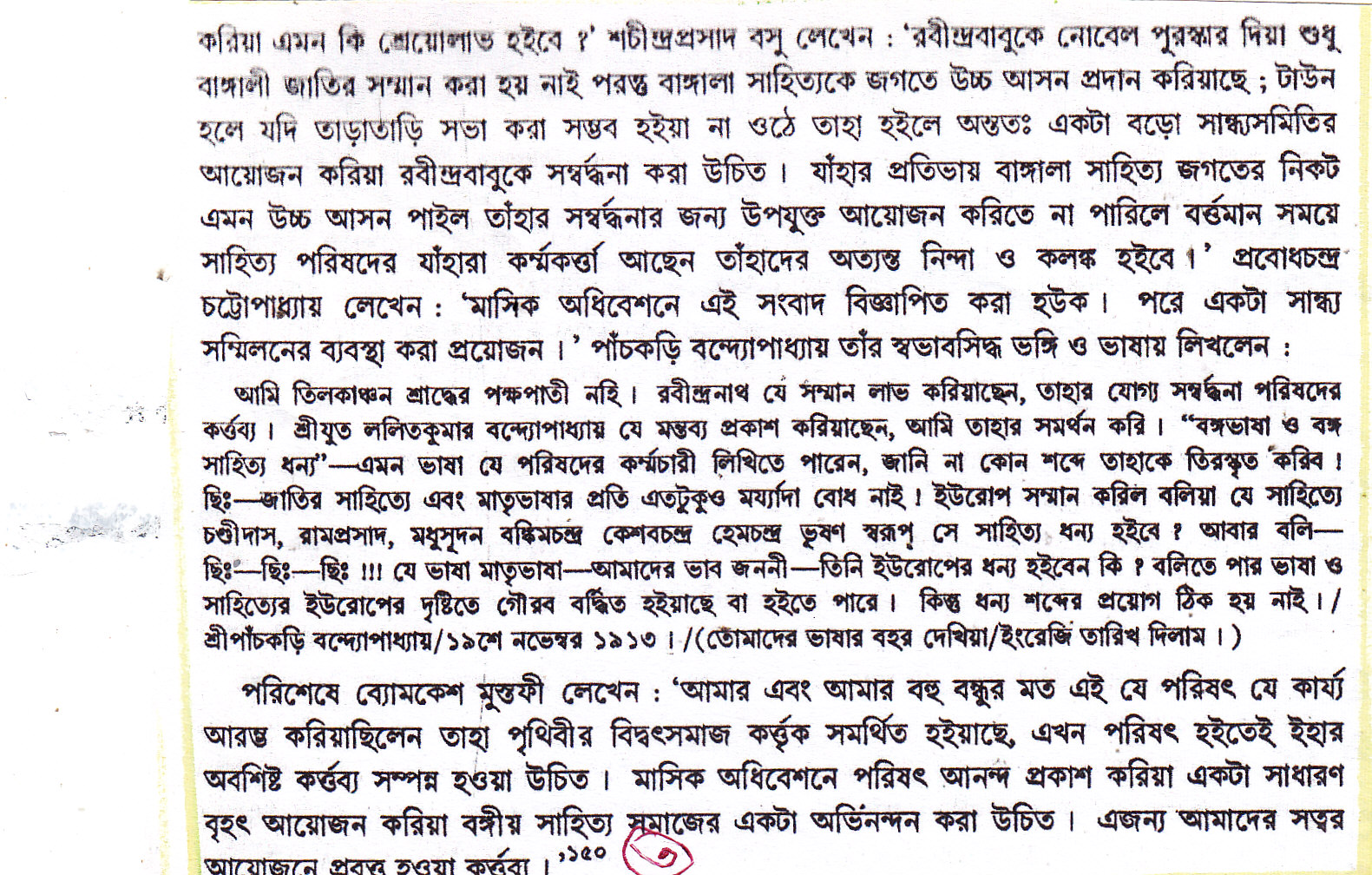
Some paper cuttings of Rabijibani by Prasanta Kumar Paul is attached.

Tuesday, November 22, 2011

Rabindranath won the Nobel Prize (contd-2)

The students and teachers at Santiniketan, all became happy and excited. The then student Pramatha nath Bishi wrote, "I observed that the movements of Ajoy Babu as gradually becoming rhythmic like dancing. and Kshitimohan Babu who  was sober in his attitude and restrained in his movement, he also seen to be restless". It was written on the notice board (Ashram Katha) that  the school will remain closed for 4 days because Acharya of our Ashram Rabindranath Tagore  won the Nobel Prize for literature this year (1913)."
The Bolpur Post Office remained busy for some more  days.Telegrams were coming from different parts of the world, within and outside the country, congratulating Rabindranath Tagore . Innumerable letters were also coming. to Rabindranath.  He was in  the habit of answering all the letters by his own hand but the volume of the work was so huge that it was essential to take some mechanical aid in answering the quarries and congratulations.
The letter containing the words, "I am offering my gratitude to those who have expressed their happiness in my honour of being Nobel Laureate this year. thanks , 1st Agrahayan 1320.", written in Rabindranath's own handwriting was cyclostyled and to all well wisher.
Apart from these he himself replied to some persons of importance in his own handwriting.He replied on that day to Ramendrasundar Tribedi;
" A spectre is haunting me and I am searching for a exorcist. I am unable to join in your joy.You may think that this is my exaggeration  but my inner self knows how much heavy is my mind. I have started translating my Gitanjali with the words,
' Kolahal to baran holo/ebar katha kane kane'
      But you see how far the success of prevention it may proceed."
Congratulating Rabindranath, Rothenstein wrote a letter and a telegram . In reply to that Rabindranath replied on 18th Nov.,
" The very first moment I received the message of the great honour conferred on me by the award of the Nobel prize my heart turned towards you with love and gratitude. I felt certain that of all my friends none would be more glad at this news than you. But, all the same, it is a very great trial for me. The perfect whirlwind of public excitement it has given rise to is frightful. It is almost ax bad as  tying a tin can at a dog's tail making it impossible for him to move without creating noise and collecting crowds all along. I am being smothered with telegrams and letters for the lats few days and the people who never  read a line of my works are the loudest in their protestations of joy."
Calcutta University had decided to offer honourable D.Lit to Rabindranath on 28th Nov and that was approved on 15th Nov.
In a special convocation in Governor House, Calcutta, on 26 Dec Rabindranath was awarded D,Lit .
The lovers and followers of Rabindranath had already started a big arrangement for celebrating  the occasion of winning the Nobel prize by Rabindranath. In a special hired train they would go to Santiniketan on 23rd Nov. to congratulate him. This news was circulated in  The Indian Daily News  on 19th Nov asking the willing persons to deposit Rs. 3.25 as a train fair. The news was signed by ; Surendranath Banerjee, Brajendranath Seal, Prafulla Chandra Roy, Satish Chandra Vidyabhushan, W.E.S., Holland, Nilratan Sarkar and Roy Jatindranath Choudhury etc. Another advertisement was published under the signature of A. Rasul, Hirendranath Dutta, Fazlul Haque, and C.F. Andrews.
Under these circumstances a notice was served signed by the Secretary, Bangiya Sahitya Parishad and countersigned by the President Haraprasad Shastri convening  a meeting of the Working Committee of the organisation on 21st Nov. The resolutions adopted in the meeting as recorded in the minute book was;
1. The letter of Ramendra Babu was read and it was decided to send a letter of thanks to the Swedish Academy,
2. Approving the proposal of Ramendra Babu the President send the Telegram to Rabindranath in the following lines;
"Hearty Congratulation on the Triumph of Rabindranath and the recognition of the Bengali literature through him by European nations. A deputation of the Bangiya Sahitya parishad will reach Bolpur on Sunday.
It was also decided after a lot of discussion that the would be team going to Santiniketan to hand over the resolutions would also invite him for a felicitation meeting of the Parishad.
3. President of the Parishad proposed to offer a golden ink-pot and a golden pen to the poet Rabindranath. The details of the programme would be decided afterwards.,
4. the following accepted proposals in this regard were as follows;
i) For whom the Bengal is proud to today, for whose genius the Bengali literature is glorified today, for whose creation the Bengali literature has got a seat in world's literature , for whose honour India is flooded with joy, as a mouthpiece of Bengali literature, the Bangiya Sahitya Parishad is joining the chorous of joy in the whole of Bengal,
ii) The Swedish Academy, after thorough reading of the creation of Dr. Rabindranath Tagore has conferred the best honour Nobel Prize to an important member of the Parishad and became thankful to the members of the Parishad,
iii)The Parishad would arrange for celebrating the felicitation of  the eternal friend of the Parishad Dr. Rabindranath Tagore in a befitting manner,
iv) The following persons be selected for inviting Dr.Rabindranath Tagore in Bolpur for this felicitation at Calcutta,
Haraprasad Shastri,Ashutosh Choudhury, Saradacharan Mitra, Roy Jatindranath Choudhury, Satish Chandra Vidyabhushan, Hirendranath Dutta, Ramendrasundar Tribedi, Rakhaldas Bandyopadhyay, Panchkari Bandyopadhyay, Saileshchandra Majumdar, Manmohan basu, Kaviraj Durganarayan Sensashtri, and Byomkesh Mustaffi.
For arranging this  deputation, the monthly meeting of the Parishad was suspended.
Having  known the news of this deputation, Santiniketan was getting herself prepared for welcoming the guests  properly with fireworks and sweets.
The felicitation of the people coming from Calcutta in a hired reserved train was recorded in several documents written by different persons. 1. Punyasmriti by Sita Devi, 2. Bolpur-e Rabindrasambardhana by Fakir Chandra Chattopadhyay, 3. Santiniketan-e Ekdin by Krishnabehari Gupta, and in other books.. Apart from this Pulin Behari Sen in his book published in the issue of Rabindrajanma Satabarsha - 1368, wrote in details of the description of this felicitation.
The special train carrying the important persons from Calcutta started on 23rd Nov. at 10.55 AM for Bolpur.The train was decorated with flags and a band party also accompanied them. At about 3 PM the train reached Bolpur carrying 500 persons ( males and females) and they were welcomed by Andrews putting Dhoti and Chadar and students with Saffron coloured dress. The paper of ovation written by the poet Satyendranath Dutta which had been discovered recently.      
           

Saturday, November 19, 2011

Rabindranath won the Nobel Prize for Literature in 1913 (contd-1)

The address of Rabindranath Tagore was not known to the authority of Swedish Academy and ,therefore, they informed Tagore the news officially from London through Macmillan on 14th Nov in the following lines;
XF PH LONDON PO 14 EASTN LN19 RABINDRANATH TAGORE 6 DN TAGORE?LANE JORASANKO CALCUTTA
SWEDISH ACADEMY AWARDED YOU NOBEL PRIZE LITERATURE PLEASE WIRE ACCEPTATION SWEDISH MINISTER
CALCUTTA/15 NO 13/GPO on receiving the above  telegram,  the son-in-law Nagendra informed the news to Rabindranath at Santiniketan by wire on 16 Nov,  in the morning 7-10 AM ;
"Following cable received midnight Swedish academy awarded you Nobel prize for literature please wire acceptation swidish minister = nagen=
The news was first published in the evening-paper Empire ;
GREAT HONOUR FOR?TAGORE?NOBEL PRIZE CONFERRED./"LARGEST CONTRIBUTION TO/THE COMMON GOOD"/(REUTER'S SERVICE)/LONDON, THURSDAY.
The Nobel Prize for literature has/been conferred on the Indian poet, Rabindranath Tagore.
The paper also described the "History of the Nobel Prizes" and endorsed the names of winners from 1901 to 1913 i.e., the 14 names, winners of Nobel Prize for literature.
Having the above news in the paper, the lovers of Tagore sent separately enumerable telegrams to Bolpur, the first of which was ;
Handed in at Calcutta 14 16 10 Recd. here at 16.43 
Rabindranath Tagore/Santimniketan/Bolpu
Nobel prize conferred on you our congratulations
= manilal satyendra charu
i.e., Manilal Gangopadhyaya, Satyendranath Dutta, and Charuchandra Bandyopadhyay sent the telegram at 4.10 PM from Calcutta which reached Bolpur Post Office at 4.43 PM.
On 26th may, 1921, Rabindranath himself said in his Nobel-lecture delivered at Stockholm of Sweden;
" I remember the afternoon when I received the cablegram from my publisher in England that the prize had been awarded to me. I was staying then at the school of Santiniketan, about which I suppose you know. At that moment we were taking a party over to a forest nearby the school, and when I was passing by the telegram office, a man came running to us and held up the telegraphic message. I had also an English visitor with me in the same carriage. I did not think that the message was of any importance, I just put it into my pocket, thinking that I would read it, when I reached my destination. But my visitor supposed he knew the contents, and he urged me to read it, saying that it contained an important message. And I opened and read the message, which I could hardly believe. I first thought that possibly the telegraphic language was not quite correct and that it might misread the meaning of it. And you can well understand how rejoicing it was for my boys at the school and for the teachers."
The biographer of Rabindranath was present at the school at Santiniketan; he wrote;
" After the reopening of the school on 15th Nov. the poet, Rathindranath and Dinendranath were going for a outing by a motor car through the Saal forest of Chaupahari, they received the telegram enroute their journey which read as "Rabindranath received the nobel prize on literature for 1913 for literature. The telegram was sent by Satyendranath Dutta. The news was brought by Nagendranath and it was annonced at the time of lunch in the kitchen."
Thomson wrote in his description that about 4.30 PM I had my tea . He (Rabi)came in suddenly and said "Mr. Thomson, will you excuse me for a few hours? I have to go somewhere."
           

Friday, November 18, 2011

Rabindranath won the Nobel Prize for Literature in 1913

It was only for the struggle of two persons the genius of Tagore was recognized by the Nobel Committee for Literature.
Heidenstam's letter and  the report of Per Hallstrom influenced the members of the Nobel Committee for Literature. Gunnar Ahlstrom wrote;
"More and more of the Academicians began to read Gitanjaliand gradually succumbed to the charm of these rhythmic ideas. Then the unexpected happened. The Committee's recommendatiom in behalf of Emile Faguet was rejected by a by a decision of the Academy in pleno. Of the 13 who voted on November 13, 12 were in favour of Rabindranath Tagore."
The news was published  from Stockholm, Thursday, Nov 13 on that very day.: The Nobel Prize for literature for 1913 ha s been awarded to the Indian Poet Rabindranath Tagore. Reuter's Services from London circulated it through out the World. They also announced the prize money of 8000 Pound and a list of winners winners from 1901 to 1912.
Rabindranath was almost unknown to the world. the reporters of different paters from world began to collect informations about Rabindranath Tagore.Some papers of England and some papers of Chicago were lucky to know earlier some about Rabindranath still some of their datas circulated were not correct.
Evening Post, New York, Nov 13, wrote that ' the first time on record that the prize has been given to anybody but a white person.'
Times of Los Angels wrote on 15 Nov, under the title " The ignoble Decision/Hindu Poet Unworthy of Nobel Prize' said;
"The Nobel prize for Literature has been awarded to a Hindu poet whose name few people can pronounce , with whose work fewer in America are familiar, and whose claim for that high distinctionstill fewer will recognize."
Some papers even grambled for giving the prize to an unknown leaving behind some important poets like Tomas hardy, Anatole france etc.    

Thursday, November 17, 2011

More on Recommendation of Nobel Prize of Rabindranath (contd-1)

After writing the third phase of his recommendation, Per Hallstrom  approached the Nobel Library of Stock Home for further information about Rabindranath Tagore. Being requested  The Times Book Club of 376 to 384, Oxford Street of  West London ,  contacted with the publisher Macmillan of Rabindranath. Afterwards the Secretary of the Times Book Club, G.F.James wrote to Strangways on 20th May, 1913,
" We have been referred to you by Messrs. Macmillan in connection with an enquiry we have received for a list of books in the Bengali language by Rabindranath Tagore, also for any articles  which have appeared either dealing with this author or his work. If you could assist us in answering the enquiry we should be very greatly obliged. I may add that the enquiry comes from the Nobel Library at Stockholm, and that the fullest possible information is likely to be of use to Mr. Rabindranath Tagore in that quarter."
Having received this letter Fox Strangways sent the paper cuttings containing the criticism about Rabindranath published in the papers The Times, The Fortnightly Review, The Nineteenth Century etc.Per Hallstrom wrote his second part of recommendation on Gitanjali..
   Harald Gabriel Hjärne (Klastorp, Skövde 2 May 1848 – Uppsala 6 January 1922) was a Swedish historian.Hjärne held one of the chairs of history at Uppsala University from 1889 until 1913, and was a member of the Swedish Academy from 1903. He was a member of the Second Chamber of the Riksdag 1902-1908 and of its First Chamber 1912-1918.
But the Nobel Committee under the chairmanship of Harald Hjarne did not approve the name of Rabindranath Tagore for the Nobel prize.
Gunnar Ahlstrom informed that in total 28 recommendations were submitted for Nobel Prize for Literature this year.
The following are the names of the candidates with their recommendations against each of them as the contestants for the prize;
1. Thoma Hardy (1840-1928) - Recommended by 97 members of the Royal Society of Literature of England,
2.  Benito Perez Galdos (1843-1920) - Recommended by 700 persons from Spain.
3. Carl Spitteler (1845-1922) - from Switzerland,
4. Grazia Deledda (1875 - 1936) - from Italy, 5. Earnest Lavisse (1842 - 1924) - from France, 6. Pierre Loti (1850 - 1923)  and 7. Antole France (1844 - 1924) - from Germany. Apart from these there were names from Denmark, Finland, Sweden, Belgium, etc.
High recommendations by Per Hallstrom about Rabindranath was not able to mould the mind of Hjarne.
Later on Anders Osterling (1884 - 1981), permanent Secretary of Swidish Academy and a member of Nobel Committee wrote'
" It is true that Harald Hjarne , the then Chairman of the Committee, was unwilling to commit himself and expressed the opinion that it must be difficult to decide how much in Tagore's enchanting poetry was his own personal creation and how much must be attributed to the classical traditions of Indian literature. Therefore the Committee gave serious consideration in the first place to another author who had been proposed, Emile Faguet (1847-1916), the French literary historian and moralist."
There was a member in the Swedish Academy who knew Bengali, he was an old man and an orientalist, Esaias Henrik Vilhelm Tegner (1843 - 1928),  the grandson of the famous poet of Sweden -  Esaias Tegner (1782 - 1846).    He, too, could not convince the other members of the Nobel Committee.
When the Swedish Academy comprising of Professors, Bishops, Government Officials, writers etc placed its decision, the  contemporary and most famous poet of Sweden, Carl Gustaf Verner von Heidenstam (1859 - 1940), a nominated member ( just nominated on 26.9.1912 and got Nobel prize for Literature on 1916, there was no award on 1914 and 1915 due to war) of Swedish Academy came forward in support of Rabindranath Tagore. He was moved by reading Gitanjali translated by Anrea Butenschon in Swedish.     

Wednesday, November 16, 2011

More on Recommendation of Nobel Prize of Rabindranath

On 28th Oct. Vice-Chancillor Ashutosh Mukhopadhyay proposed in a meeting of the Syndicate of Calcutta University proposed to offer honourable Doctor of Literature to Rabindranath along with other six persons. Syndicate decided to send the proposal to Senate for its sanction.In about 15 days time Swidish Academy published the name of Rabindranath as a winner of Nobel prize in Literature for 1913. The propsal of Ashutosh Mukhopadhyay to offer Honourable D. Lit to Rabindranath saved the Calcutta University from shame. It is to be mentioned  here that just before one year "Pathsanchoy" written by Rabindranath was refused to be selected by the Textbook-Selection-Committee of Calcutta University.
Thomas Sturge Moore, as a member of Royal Society of Literature of Great Britain, recommended the names of Rabindranath to the Swidish Academy for Nobel Prize. There was no mention about the identity of Rabindranath or anything about the his creation in the letter of recommendation. But it attracted  the members of the Swidish Academy for its novel style of recommendation.Sturge Moore was not at all unknown to The Academy Gunnar Ahlstrom in his essay " The 1913 Prize'wrote;
"In 1911 Sturge Moore was elected to an important post in the Royal Society of Literature, whose concern it had been since 1912, to watch over the interests of  England with regard to the Nobel Prize."
Per halltrom (1866-1960) , a member of Nobel Committee and an Academician, had been given the charge of judging the merit of the proposal and the last date of submitting his report was 29 Oct. 1913.
   Per Hallström and his wife.Per Hallström (1866, Stockholm – 1960) was a Swedish author, short-story writer, dramatist, poet and member of the Swedish Academy. He joined the academy in 1908, and served as its Permanent Secretary from 1931 to 1941. Before devoting himself to writing, Hallström worked in London and Chicago as a chemist. He is appreciated primarily for his collections of short stories, such as Purpur [Purple] (1895) and Thanatos [Death] (1900). His major works, written before 1910, combine profound compassion with a sensitive awareness of beauty.[citation needed] Between 1922 and 1946, Hallström served as Chairman of the Nobel Committee of the Swedish Academy for the Nobel Prize in Literature.

   The translated form of the report of the recommendation of Hallstrom was published in Indian Literaure  (Vol. 4. 1961) in the essay "Tagore and Nobel Prize" written by Arvid hallden. It revealed that Hallstrom had taken much time to prepare the report -- it was written in three stages. In the first stage he wrote about Gitanjali, in which he said ;
" The small collection of poems... creates such a surprisingly rich and genuinely poetic impression that there is nothing odd or absurd in the proposal to reward it even with such a distinction as it is a question here." and here he found, " something more remarkable than anything that European poetry has to offer at present.". He expressed his decision, " There is no mistaking the exceptional poetic beauty. The mode of expression is of classical simplicity, the image is only the spontaneous language of thought, and it does not need to be moulded into shape, it is even complete through the mere mention of the word."
Before writing about the next phase of his recommendation he found the criticisms of Ezra Pound in The Times, (7th Nov 1912) & The Fortnightly Review (Mar 1913), of Arnest Ridge in The Nineteenth  Century (April 1913).  He got in these criticisms which he incorporated in his second phase of recommendation in the line of its outward structure. The third phase of his recommendation he wrote after getting  " The Gardener".Hallstrom did not find any shortage of beauty in these poems of love. Quoting several poems he wrote in his decision;
" It is certain, however, that no poet in Europe since the death of Goethe in 1832 can rival Tagore in noble humanity, in unaffected greatness, in classical tranquility."