Thursday, September 9, 2010

Balaka, Jyotirindranath Tagore

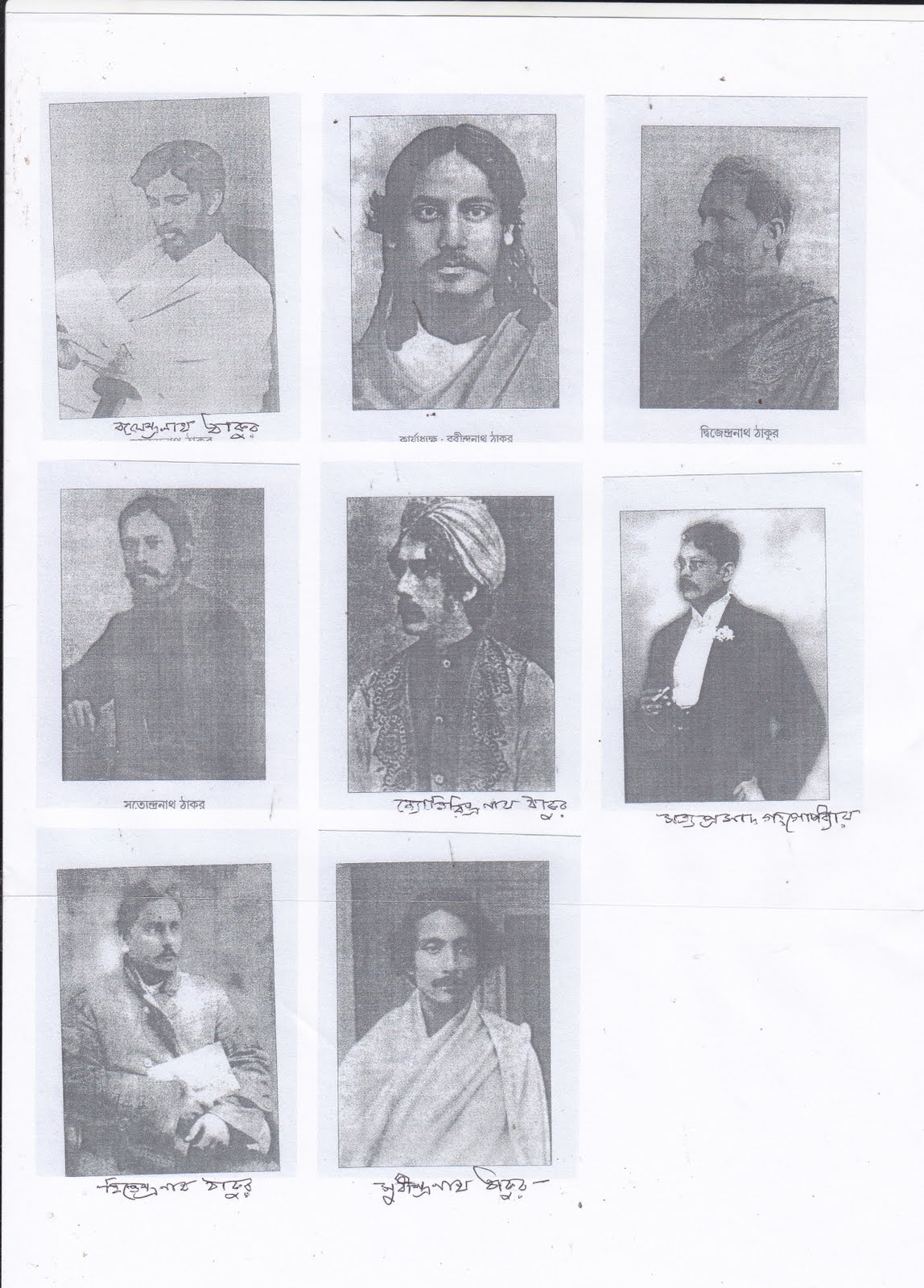
Jyotirindranath (1849-1925) was the 6th child and 5th son of Debendranath Tagore. Rabindranath called him  'Natun Dada'. He was also in favour of the freedom of women. His wife Kadambari was the first lady who went to the Maidan from Jorasanko on horse back. He had talent in instrumental music and art. In 1914 Rodenstein published a collection of his 25 oil paintings of which he wrote the introduction. In his essays written for Balaka he had drawn illustrations.

Balaka, Satyendranath Tagore


Satyendranath (1842-1923), the second son of Maharshi Debendranath Tagore, was educated at Hindu School and Presidency College. Keshab Chandra Sen was his classmate in college. In 1859 he went to Ceylon with his father and was married with a 8 year old girl, Gnanadanandini, daughter of Abhoy Charan Mukhopadhyaya. From his very boy-hood he was an active supporter of freedom of women. He didn't keep his wife confined within the four walls of his residence. Swarnakumari Devi wrote that her 2nd elder brother came back to India after passing ICS. When he first joined his office he took his wife to Bombay.  He sent his wife to England with her two children. This caused much controversy in contemporary society. He was  a senior Govt. officer from 1865 to 1897 and came back to Calcutta after retirement.  After coming back to Calcutta he joined the then Nationalist Movement against the order of  Lord Curzon to partition Bengal in 1905. He wrote many songs which inspired his countrymen. He also took a role of editting Tattwabodhini Patrika. He became president of Bangiya Sahitya Parishad. He was Acharyya of Brahmmo Society for a long time. He constructed many Brahma Sangeet. His important works were - Shushila O Birsingha, Bombai Chitra, Balykatha, Freedom of Womem and British in India. He translated Meghdut kavya. With the help of his daughter, Indira, he translated the Autobiography of Maharshi Debendranath into English. He died of piles. His daughter described how he asked for oxygen in the last stages. Rabikaka came and sat on the floor to pray to God.
Of the many articles he wrote for Balaka, 'Bombai Sahar' was one with the map of the city.            

Wednesday, September 8, 2010

(Video) Chirosakha he........ rabindra sangeet

Balaka, Dwijendranath Tagore

Dwijendranath Tagore wrote an essay on Philology of Bengali Language
suitable for children.


Tuesday, September 7, 2010

Balaka, Narendrabala Devi


Narendrtabala was born in 1864. Her father Mrytunjoy Mukhopadhyaya was a judge in Allahabad. She was married to Satyaprasad son of Saudamini, daughter of Maharshi Debendranath, on 22 February 1877.  Maharshi Debendranath was present at the marriage ceremony. In 1879 she gave birth to a child who died in his childhood. Her eldest son, Suprakash, was born in 1884. She had good relations with Jnanadanandinii. When Jnanadanandini lived in the house at Park Street, she visited frequently. She wrote some essays in Balaka for children. She was the first lady who wrote essays on science in Bengali. Rabindranath compiled a book, "Chutir Para," written by her.
In Balaka Narandrabala wrote an essay "Surjer Katha" (Story of Earth, Sun). In this essay she tried to explain the size of the sun in comparison with earth, its distance from earth, and the amount of heat and light it generates in a very nice way.     .

Monday, September 6, 2010

Balaka, Prativa Sundari Devi

Prativa Sundari Devi (1866-1922) was the daughter of Hemendranath, the third son of Debendranath Tagore.  She was the only woman in Thakur Bari  who was highly educated. She studied in Bethune and then in Loreto. She was exceptionally brilliant in music. She mastered both eastern and western music. She took the role Saraswati in Balmiki Prativa in its first performance  and was highly appreciated. Bankim Chandra was present on the occasion. Not only in performance she had contributed to some theoritical aspects of music.She also gave notations to Rabindranath's lyric and earned a reputation. The notation of the song "Bal Golap More Bal" of Tagore was done by her  which was  the first  printed notation of Tagore's lyric. She was married to Ashutosh Choudhury. She continued singing even after her marriage. She took an important role in publicising and circulation of  Tagore songs.She founded a school for music with the name of "Sangeet Sangha". This school felicitated Rabindranath on 21st Aug 1921 for winning the Nobel Prize.
In Balaka, she wrote an article in which she discussed Marga Sangeet. In her article she also gave notations to some of the songs and discussed some basic points on music.  "Balaka" was a magazine for children, but it contained different departments. e.g., travel, drama, exercise, music and editorial with letters to the editor. Prativa Sundari Devi was in charge of the column on music. She wrote many essays on music in 'Balaka' covering 41 pages in the compiled book. In fact she tried to give an introductory lesson in music through this medium under the title "Sahaje Gan-shiksha". She discussefd about beats, gaps with examples.